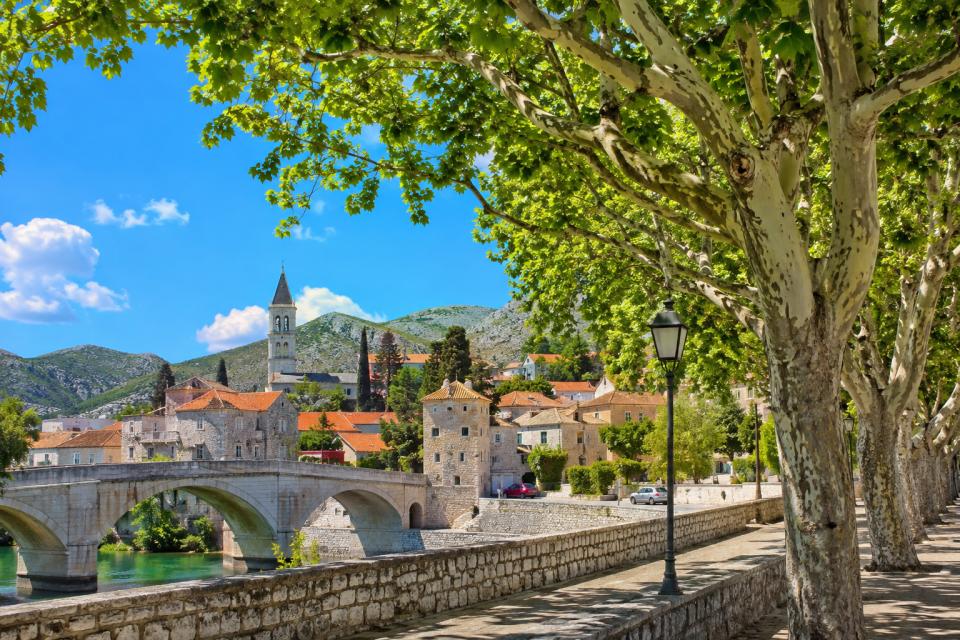

The rain was falling sideways when Emma stepped out of Sarajevo International Airport, and her first thought was that the guidebooks had lied. They said this was a city of Ottoman elegance and Habsburg charm, but through the grey October downpour, it looked like every other struggling post-war capital in Eastern Europe-functional, worn, honest in a way that made you uncomfortable. She'd booked a modest hotel in Baščaršija for seven days and planned to file a piece on "emerging Balkans destinations" for a London travel publication. She had a return flight booked. She had a flat waiting in Manchester. She had, as she would later joke, an entire life waiting for her to come back to.
She did not come back.
Walking through the cobblestones of the old bazaar that first afternoon, Emma was struck not by the postcard version of Sarajevo, but by its refusal to perform for tourists. The cafes weren't decorated with faux-antique signage. The old men in the corner weren't arranged for Instagram. People simply sat, drank coffee that arrived in small copper pots, talked for hours about nothing in particular, and seemed deeply unbothered by the gray sky. There was something almost radically honest about it.
She filed her article. It was professional, competent, and forgettable. She did not mention that she'd spent four hours in a kafana in Baščaršija having a three-person conversation in broken English and gestures about the difference between Bosnian coffee and the coffee in Istanbul. She did not write about the architecture student named Adnan who'd spent two hours explaining the geometry of the Gazi Husrev-beg Mosque. She did not mention the feeling that crept up on her the night before her flight back—a feeling that she was leaving something important unfinished.
Six weeks later, she bought a return ticket.
What Nobody Tells You About Dating a Local
The story of how she stayed is also the story of how she fell in love, though neither happened in the order or timeline she would have planned. Adnan was not her type—or rather, he was nobody's type until you spent enough time sitting in a cafe with him, watching him sketch buildings on napkins, listening to him talk about the weight of history in a city that doesn't get to forget it. He spoke careful English with a Sarajevo accent that made English sound like a language designed specifically to be kind. He was patient with her pronunciation. He never corrected her. He invited her to meet his family, which, she would later understand, meant considerably more than it would in London.
Meeting his family meant three hours at lunch. It meant his mother had cooked for three days. It meant she was being assessed not for whether she was worthy of Adnan, but whether she was genuine. There was no small talk in Bosnian culture, Emma discovered. Small talk would be insulting to everyone's intelligence. You either engaged in real conversation or you stayed quiet. She learned to sit with silence. She learned that a question about whether she wanted more burek was never just about food.
But staying for love, she found, was not enough to stay in a place. Staying required surviving the bureaucracy, the language, the sheer weight of cultural difference that sits on your shoulders every single day. It meant navigating a society where gender roles, while quietly shifting, still moved slower than she was used to. It meant her British directness—which she'd always seen as honesty—was sometimes read as coldness. It meant her mother, calling from Manchester, asked every month when she was coming home.
"You don't understand," Emma's mother said after the first year. "You're living in someone else's country."
"So is everyone," Emma replied. "I'm just more honest about it."
Learning to Exist at a Different Speed
The real culture shock wasn't the Cyrillic alphabet or the politics or even the architecture. It was the coffee. Not the coffee itself—though yes, that too, the way it arrived in a small copper pot called a džezva, the ritual of it, the grinding of beans, the pause, the pouring, the settling—but what the coffee represented. In London, Emma had drunk coffee like she drank everything: quickly, on the move, as fuel between destinations. In Sarajevo, coffee was the destination.
This was ćejf, the concept she'd first encountered in that kafana during her initial visit. Ćejf isn't just relaxation; it's a philosophy of being present. It's sitting in a cafe for three hours and calling it a productive afternoon. It's a state of mind that rejects productivity culture entirely. For someone from a London where "busy" was a status symbol and "relaxation" was something you scheduled, ćejf felt almost like a personal rebuke.
But it also felt like salvation.
During her second year in Sarajevo, Emma made the decision to stop trying to recreate her London life in a Sarajevo package. She stopped applying for jobs at international NGOs. She stopped going to expat meetup groups where everyone complained about the internet speed and the bureaucracy. Instead, she registered as a freelancer, worked for European clients on design and copywriting, and gave herself permission to work in the rhythm of the city rather than against it. She took afternoons off. She sat in kafanas. She started to notice that her anxiety, which had been a constant hum in London, had simply... stopped.
Her in-laws noticed the change before she did. "You're Sarajevo now," Adnan's mother said one afternoon, and it wasn't unclear whether this was a compliment or a diagnosis.
The turning point was the wedding. They got married three years after Emma arrived, in a combination ceremony that satisfied neither her secular British expectations nor the Orthodox traditions on Adnan's father's side, but somehow worked anyway. At the reception in a restaurant overlooking the city, surrounded by people who spoke languages she still couldn't fully understand, Emma realized that she'd stopped translating her life. She wasn't the British woman living in Sarajevo anymore. She was just living.
Running a Life Between Two Worlds
Today, five years after that first rainy arrival, Emma and Adnan run a small design studio from a renovated Ottoman house in the Old Town. They work with international clients—mostly hotels, tourism boards, cultural organizations across Europe who want design that's rooted in place rather than lifted from a global template. Emma's British eye for brand strategy combines with Adnan's intimate knowledge of Sarajevo's architectural language. It works better than either of them expected.
But the life she's built isn't without friction. Her family still doesn't fully understand why she won't come home. Her mother makes comments about "wasting her education." The visa paperwork is endless—even after marriage, bureaucracy moves at the speed of Sarajevo time, which is to say, glacially. She's had to learn Bosnian, a process that remains humbling and occasionally humiliating. She's navigated the low-level sexism of a traditionally-minded society, the way certain older men in business meetings barely make eye contact, the assumption that Adnan is the real architect and she's just his English wife.
But she's also learned that most of those older men warm up the moment you ask them a genuine question about their work, their city, their history. She's discovered that saying "I don't know" in Bosnian is endearing rather than weak. She's found a community of other expat women in Sarajevo—not at organized meetups, but through actual friendships, through kafanas, through the slow work of real integration.
The hardest part, she says now, is the small separations. When her father had a heart attack two years ago, she couldn't just drive to Manchester. She had to arrange flights, time off, navigate the guilt of being five hours away when she needed to be there in an hour. Her brother got married without her. Her nephew was born and she met him at six weeks old. These aren't small things.
But she also has something her London friends don't seem to have: she knows her neighbors. She knows the man who runs the produce stand understands her terrible Bosnian and prepares her vegetables anyway. She knows the rhythm of her city—when things close, when things open, which kafana is good for working and which is good for sitting. She knows the weight of history because she lives in it, not because she read about it.
When people ask her if she'd do it differently, she pauses. "I'd probably be more intentional about learning the language from the start," she says. "And I'd tell anyone considering this to be very honest with themselves about whether they're running toward something or running away. But regret? No. I landed here by accident and stayed by choice. That matters."
She still goes back to Manchester once a year. She still speaks English with her mother over video calls. She still has moments where she misses the efficiency of the UK, the trains that run on time, the ability to complain about the weather to a stranger and have them understand exactly what you mean.
But then she sits in a kafana, ordering her coffee from a waiter who doesn't rush, and Sarajevo just makes sense again. The week she came for became a life. The life became real. And somewhere between the Ottoman architecture and the ćejf and the man who sketches buildings on napkins, she stopped waiting for her real life to begin.
Sources:
Sarajevo Times: "Business Owner from Britain reveals Advantages of living in Bosnia and Herzegovina" & feature on female expats in the Balkans
Expatica interviews on living in Sarajevo
General expat accounts and interviews from Expat.com and ExpatsBlog
Cultural observations from multiple British expat sources on ćejf and Bosnian lifestyle