
You call yourself diaspora, but to a clerk in Sarajevo or a clerk at the consulate in Frankfurt, you might simply be a citizen whose paperwork is overdue. The gap between what the law already grants you and what your documents actually show can mean the difference between a two-month process and a two-year runaround.
This opens a series we're running for second and third generation Bosnians born in Germany, Sweden, Austria, the US, and Australia who are weighing a return, buying family property, sorting out a parent's pension, or just want their kids to hold a Bosnian passport. We're starting with the foundation: citizenship itself.
Who already qualifies, and who still has to prove it.
Bosnia's citizenship law separates acquisition by descent from naturalization, and for diaspora families the first category matters most, since it requires no residency, no language test, no waiting period. A person born abroad qualifies for BiH citizenship by origin if one parent held BiH citizenship at the time of the child's birth. The same applies, obviously, when both parents are BiH citizens, regardless of where the child was born.
The catch is administrative, not legal. Citizenship by descent exists from the moment of birth, but no authority in Bosnia knows about it until it's formally registered. That registration is called naknadni upis, subsequent entry, and it's the paperwork that separates "I am a citizen under the law" from "I hold a certificate that proves it and can apply for a passport."
There's also a deadline many in the diaspora don't know about. People with only one BiH-citizen parent can only complete this subsequent registration into the birth registry up to age 23. If you're 19 or 21 and reading this for the first time, don't sit on it. Older generations have it easier: anyone born before January 1, 1998 has the right to register their birth and citizenship later in life without that age cutoff.
What "grandchild of a Bosnian citizen" actually means.
This is where diaspora forums tend to oversimplify. The law speaks about a parent, not a grandparent. If your mother or father held BiH citizenship at the time you were born, you qualify by descent. If your parent was born abroad and was never formally registered as a BiH citizen (meaning even they don't hold a certificate), then their status has to be sorted first before yours can be. For third generation applicants, grandchildren of people who left in the 1970s or 1990s, the real first step is confirming whether your parent was ever formally registered, not assuming citizenship simply passes down through a grandparent.
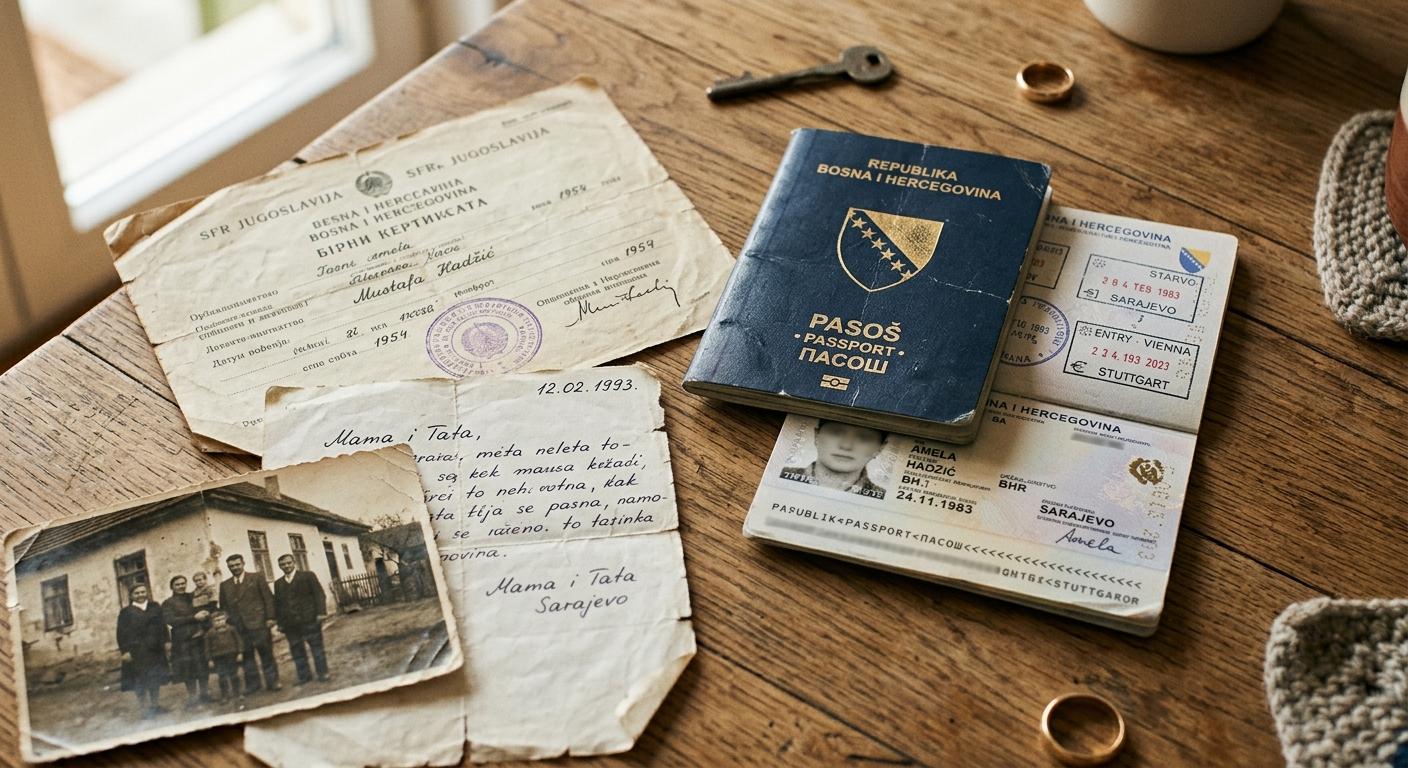
If you're not sure whether your parent is registered, old documents are the fastest trail. An old birth certificate or an earlier citizenship certificate usually shows which office holds the record. Without those, the starting point becomes your parent's place of birth and their registered residence in Bosnia at the time you were born.
The paperwork to gather before you book a consulate appointment.
Here's a concrete example, based on the Frankfurt consulate's own procedure: registering a child born abroad requires a completed application form, the original international birth certificate, and proof of the parent's BiH citizenship, either a certified copy of a valid passport or ID, or a citizenship certificate no older than six months. Consular fees are minor compared to what they unlock: the Frankfurt consulate charges 10 euros for assigning a unique citizen number (JMB), while Munich charges 6 euros for the same service.
One practical tip from people who've been through this: scan every old family document you can find before booking anything. Old ID cards, military booklets, residency certificates, anything with a name, a JMBG, or a municipal stamp on it, can shave months off the process.
Dual citizenship: what BiH allows, and what depends on the other side.
Bosnia and Herzegovina doesn't ban dual citizenship, but it doesn't guarantee it automatically either, because the outcome ultimately depends on the law of whichever other country you hold or are seeking citizenship in. BiH citizens can hold another country's citizenship where a bilateral agreement regulates it, and even without such an agreement, Bosnia doesn't typically create problems for citizens who acquire a second passport. With Croatia, there's a formal bilateral treaty: Bosnia and Herzegovina and Croatia have a bilateral agreement on dual citizenship allowing citizens of one country to acquire citizenship of the other.
For the largest group of readers here, those in Germany, the picture recently improved. Until June 2024, Germany generally required renouncing a prior citizenship as part of naturalization. Germany's reformed citizenship law took effect on June 27, 2024, and under it Germany generally accepts multiple citizenship, meaning applicants no longer have to give up their citizenship of origin. The effect shows up in the numbers: more than 80 percent of people naturalized since the 2024 reform have kept their previous citizenship alongside their German one. In practical terms, if you're from a Bosnian family in Germany and only now considering a German passport, you no longer have to choose.
Why this matters for what comes next.
A citizenship certificate and a completed registration aren't paperwork for its own sake. They're the entry point for everything that follows: inheriting family property, registering it in the cadastre, re-registering residency if you move back, or sorting out pension questions when a parent worked in both Bosnia and Germany or Sweden. We'll cover each of those in upcoming parts of this series, since each one deserves its own article, not a footnote.
Note: Rules and fees change. Confirm the exact procedure and current costs directly with the relevant BiH embassy or consulate before booking an appointment or planning travel. Information current as of September 2026.