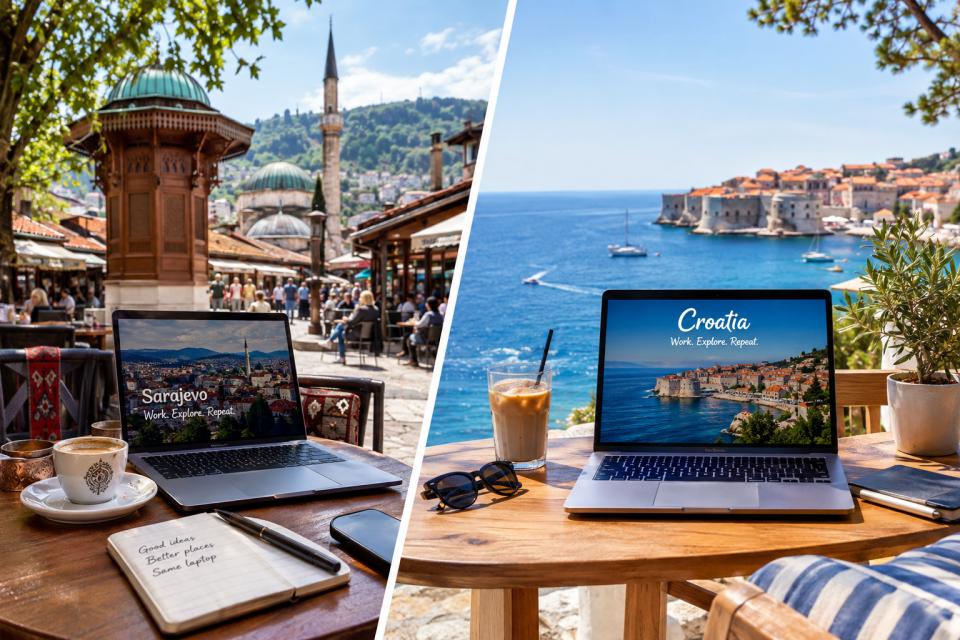

Every June, the same question shows up in Sarajevo expat groups: "I've been here two months, can I just pop over to Croatia for a weekend and reset the clock?"
No. That single misunderstanding is responsible for more panicked airport moments than any other visa myth in the region.
Bosnia and Herzegovina is not in the EU and not in Schengen, which confuses people who assume it works like its neighbors. It runs its own, separate 90-day allowance, and it does not reset just because you cross a border for coffee.
Here is what the rule actually means, who it applies to, and what your real options are once the 90 days start running out.
The 90/180 rule, explained properly
If you hold a passport from a visa-exempt country (the US, UK, Canada, EU/Schengen states, and roughly a hundred others), you can enter Bosnia and Herzegovina without a visa and stay for up to 90 days within any 180-day period. That period is a rolling window, not a calendar reset. Every day you spend inside Bosnia counts against your total, and the 180-day clock looks backward from whatever day you're currently standing in the country.
The Ministry of Security's own guidance is blunt about this: continuous or cumulative stays cannot exceed 90 days within 180 days from the date of first entry (Ministry of Security BiH, msb.gov.ba). Leaving for a weekend in Split doesn't zero out your count. It just pauses it. If you've already used 80 of your 90 days and you leave for a week, you come back with 10 days left, not a fresh 90.
One detail that trips up a lot of digital nomads working from Sarajevo or Mostar cafes: Bosnia's 90 days are separate from the Schengen 90/180 allowance. Time spent in Bosnia does not eat into your Schengen days, and vice versa. That's genuinely useful if you're doing a longer Balkans loop, since a stretch in Bosnia effectively buys you breathing room on the Schengen side. But it also means people sometimes assume the two systems are linked when tracking their own days, and miscount.
For most nationalities requiring a visa (China beyond 90 days, India, Russia, Iran, and several African and Asian countries among them), the short-stay Visa C works the same way: maximum 90 days in any 180-day window, single or multiple entry (Service for Foreigners' Affairs, sps.gov.ba). No visa-on-arrival or e-visa exists for these nationalities. Applications go through a Bosnian embassy or consulate before you travel, on paper.
What happens if you overstay
Overstaying isn't a gray area enforced loosely at land crossings, especially at Sarajevo Airport. You risk a fine, and depending on how long you overstayed and the circumstances, a re-entry ban that can range from a year to several years. If you're already close to your limit and unsure of the exact count, the honest move is to check with the Service for Foreigners' Affairs office nearest you rather than guess. Exact fine amounts and current administrative practice change, so this isn't something worth relying on secondhand blog numbers for. Confirm directly before you're in a situation where it matters.
Your real options once 90 days runs out
There are essentially three paths, and none of them is "just leave and come back."
The first is genuinely leaving the 90-day window behind: exit before you hit day 90, and don't return until enough time has rolled off your 180-day count to give you meaningful days back. This works fine for a slow traveler doing a Balkans circuit, less well for someone who's fallen in love with Sarajevo and doesn't want to leave.
The second is applying for temporary residence before your visa-free stay or Visa D expires. This is the actual path people use to live in Bosnia longer term, whether for work, study, family reunification, or property ownership. The application goes to the local field office of the Service for Foreigners' Affairs covering your registered address, and it has to be filed before your 15-day pre-expiry window closes, not after (Service for Foreigners' Affairs, sps.gov.ba). This is not a same-day process. Budget weeks, gather documentation (proof of accommodation, financial means, purpose of stay), and start early.
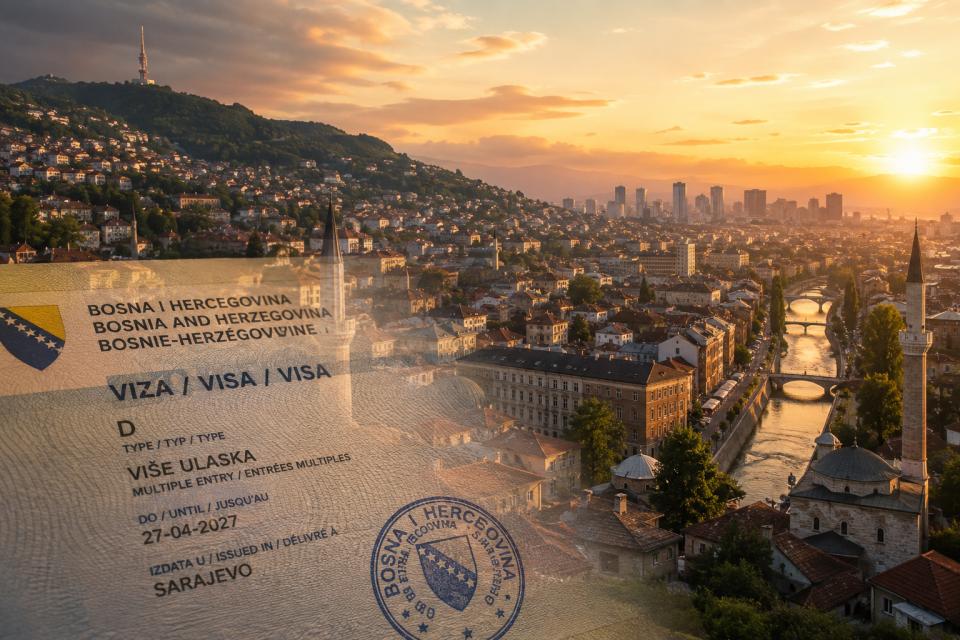
The third is a long-stay Visa D, which covers stays over 90 days for employment, education, or immigration purposes and is valid for up to a year. Visa D holders can then apply for temporary residence once they're in the country, which the Visa C tourist stamp does not allow.
There is currently no dedicated digital nomad visa in Bosnia and Herzegovina, despite periodic talk of introducing one. Remote workers here are, technically, tourists on the 90-day allowance, working in a gray zone that's tolerated in practice in cities like Sarajevo and Mostar but carries real risk if you overstay or draw official attention for any other reason.
As of September 2026 Entry rules, fine amounts, and visa-exempt country lists are updated periodically and can shift with little notice. Everything above reflects publicly available government guidance as of September 2026. Before booking anything around a specific date, check the current list and requirements directly through the Ministry of Foreign Affairs (mfa.gov.ba) or the Service for Foreigners' Affairs (sps.gov.ba).