
On Ferhadija Street there is a brass line set into the pavement where one step takes you from Ottoman Sarajevo into Austro-Hungarian Sarajevo, and that single line says more about this city than most guidebooks manage in a chapter.
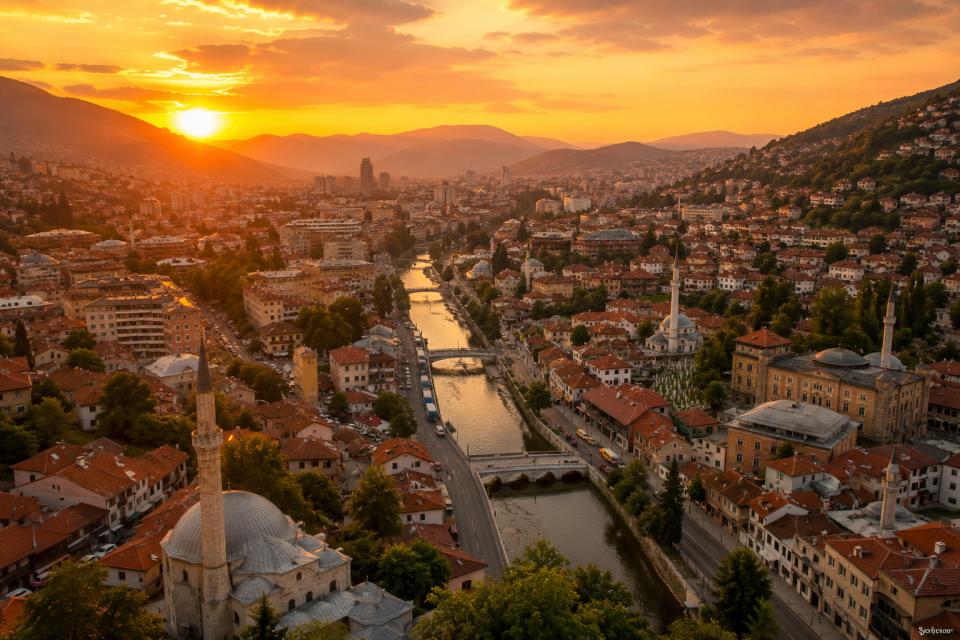
Stand on that line for a minute and look both ways. To the east: low shopfronts, narrow lanes, copper hammered by hand on Kazandžiluk street, the call to prayer drifting out of the Gazi Husrev-beg Mosque. To the west: tall Habsburg facades, a wide boulevard, a neo-Gothic cathedral, trams running on rails laid more than a century ago. The marker reads "Sarajevo Meeting of Cultures," and it sits exactly where Ferhadija Street meets Sarači Street, the seam between two empires that built this city in two completely different directions.
That seam is the fastest way to understand Sarajevo. Everything else, the history, the food, the religion, the war that nearly erased it and the city that rebuilt anyway, radiates out from that one spot in the old bazaar.
How a governor's endowment became a capital
Sarajevo did not grow slowly out of a village. It was founded, on paper, in 1462, when the Ottoman governor of Bosnia, Isa-beg Ishaković, registered a waqf, an Islamic charitable endowment, that funded a mosque, a public bath, a bridge over the Miljacka River and a caravanserai with shops attached. That document, the vakufnama, is the oldest written source historians have for the city, and it is also the reason Sarajevo has an exact founding date most European capitals cannot claim.
The bazaar that grew around Isa-beg's endowment became Baščaršija, "the main market" in a name borrowed from Turkish. Under Gazi Husrev-beg, the Ottoman governor who expanded it through the 1520s and 1530s, Baščaršija grew into one of the larger commercial centers in the Balkans, with an estimated 12,000 shops at its peak. Walk it today and you are walking a shrunken but genuine survivor of that market: the Gazi Husrev-beg Mosque, completed around 1531, still anchors the square, and craftsmen on Kazandžiluk street still hand-hammer copper džezvas the way their predecessors did five centuries ago.
Sephardic Jews arrived from Spain in the 16th century and built a synagogue and a quarter inside the bazaar itself, which is part of why Sarajevo picked up the old nickname "Mali Jeruzalem," Little Jerusalem. Orthodox and Catholic Christians lived alongside them under Ottoman rule too, with real restrictions on how each community could dress and build, but the coexistence held for centuries in a way that gave the city its enduring character as a meeting point rather than a single-culture town.
Two empires, one street
Austria-Hungary took over administration of Bosnia in 1878, and Sarajevo changed shape almost overnight. The new rulers built west of the old bazaar rather than replacing it, which is why the city still reads like two towns stitched together: Ottoman Baščaršija on one side of that brass line, Austro-Hungarian Ferhadija and its side streets on the other, with the neo-Gothic Sacred Heart Cathedral marking roughly where one gives way to the other.
The most famous single event of that period happened on a street corner a short walk from the cathedral. On 28 June 1914, Archduke Franz Ferdinand of Austria was shot near the Latin Bridge over the Miljacka, an assassination that set off the diplomatic chain reaction leading to the First World War. The corner is still there, now marked with a small museum rather than any monument to the killing itself.
The 1984 Olympics, and what came eight years later
In February 1984, Sarajevo hosted the 14th Winter Olympic Games, the first Winter Olympics ever held in a socialist country and the first in a nation where a South Slavic language was spoken. Events were spread across the mountains ringing the city, Bjelašnica, Jahorina, Igman and Trebević, all within about 30 kilometers of downtown, and Koševo Stadium (now named for footballer Asim Ferhatović Hase) hosted the opening ceremony in heavy snowfall after a nervous, nearly snowless week beforehand. The wolf mascot, Vučko, is still a familiar image around the city.
Eight years later those same mountains became artillery positions. The siege of Sarajevo began on 5 April 1992 and did not officially end until 29 February 1996, making it the longest siege of a capital city in modern warfare. By its end an estimated 13,352 people had died, including 5,434 civilians. The United Nations organized what became, at the time, the longest-running humanitarian airlift in history, delivering roughly 160,000 tonnes of food and medicine to the city in more than 12,000 flights over nearly four years. Walk the city today and the war is not hidden: bullet-scarred facades are still common, and more than 200 "Sarajevo roses," mortar scars in the pavement filled with red resin as memorials, mark spots where people died.
The city today
Population figures for Sarajevo depend on which boundary is used, and none of them are current: Bosnia has not run a census since 2013. Within the four core municipalities of the city itself, that census counted 275,524 people. Sarajevo Canton, the wider administrative area, counted 413,593. The official tourism portal Sarajevo Navigator gives a larger figure, 503,109, but that number covers what it calls "Destination Sarajevo": the city, all of Sarajevo Canton, and the neighboring municipalities of Istočno Sarajevo across the entity line in Republika Srpska. All three figures are correct for what they measure, and all three are now more than a decade old, so treat any of them as a rough planning number rather than a current count.
Geographically, Sarajevo sits in a narrow valley carved by the Miljacka River, with most of the city built up against the slopes of Mount Trebević and hemmed in on almost every side by the mountains that once hosted its Olympic glory and later its siege. That geography shapes daily life more than most visitors expect: winter fog and inversion can trap the city's air for days, while the surrounding peaks put decent skiing forty minutes from downtown in season. The four Ottoman-era municipalities of the historic core, Centar, Novi Grad, Novo Sarajevo and Stari Grad, still carry most of the city's tourist and cultural weight, while newer neighborhoods like Dobrinja and Mojmilo, built for Olympic housing in the early 1980s, sit further out.
What holds the whole place together, more than administration or geography, is that the coexistence the Ottomans and Habsburgs both built on top of largely survived the war that tried to erase it. Mosques, an Orthodox cathedral, a Catholic cathedral and a synagogue still sit within a few minutes' walk of one another in the old center, and that density of faiths in one small footprint is still what people mean when they call Sarajevo the Jerusalem of Europe.
Practical information for visitors
Sarajevo runs on a moderate continental climate: average summer temperatures sit around 19.1°C, average winter temperatures around minus 1.3°C, and the annual average is close to 9.5°C. Pack for both extremes if you're visiting across seasons, and expect real winter, not a mild European drizzle.
The currency is the convertible mark, abbreviated KM locally and BAM internationally, pegged at 1.95 KM to 1 euro. You can exchange money at any bank, post office or exchange counter, and exchange counters inside shopping centers often stay open until 22:00. Credit cards work in most shops and better restaurants, but plan to carry cash for cafés, bars, souvenir and craft shops in the old town, parking, public transit tickets and event tickets, since cards are frequently not accepted for any of those.
Bosnian, Serbian and Croatian are the official languages, mutually intelligible and functionally close to identical for a visitor's purposes. English and German are the most common foreign languages you'll encounter. Sarajevo runs on Central European Time (GMT+1). Tap water is safe to drink throughout the city. Electricity is 220V at 50Hz, standard for continental Europe.
Banks are typically open 08:00 to 18:00 on weekdays and 09:00 to 13:00 on Saturdays; the main post office runs 07:00 to 20:00, Monday through Saturday. Most public institutions keep office hours of 08:00 to 16:00 on weekdays, shops generally stay open until 20:00, and shopping centers often run until 22:00. Three telecom operators cover the country, BH Telecom, M:tel and Eronet, and prepaid SIM cards and data top-ups are sold at kiosks and shops citywide; free wireless internet is common in hotels, restaurants, cafés and malls, but roaming data costs can run high if you're on a foreign plan.